
Individuals facing persecution, violence, exploitation, and other dangers may not be able to return to their home country.
U.S. immigration law provides various forms of humanitarian protection that allow qualifying individuals to remain legally in the United States. Depending on your circumstances and the dangers you face, different humanitarian visas may suit your situation.
The team at Immigration Spurgin, PLLC, understands the stress and anxiety that come with facing an uncertain future. Schedule a free consultation with our humanitarian immigration attorney to get your case evaluated.
Don't risk your future by navigating the complexities of immigration on your own. Trust a professional to guide you through the process.
The term “humanitarian visa” is used to refer to a wide range of immigration protections available to people experiencing qualifying hardships or circumstances.
However, there’s no one universal visa that covers all forms of humanitarian relief. Each program serves different individuals, offers different protections, and has separate requirements.
Depending on the program, eligible applicants may get temporary protection from removal, permission to work in the United States, or the chance to apply for permanent residence.
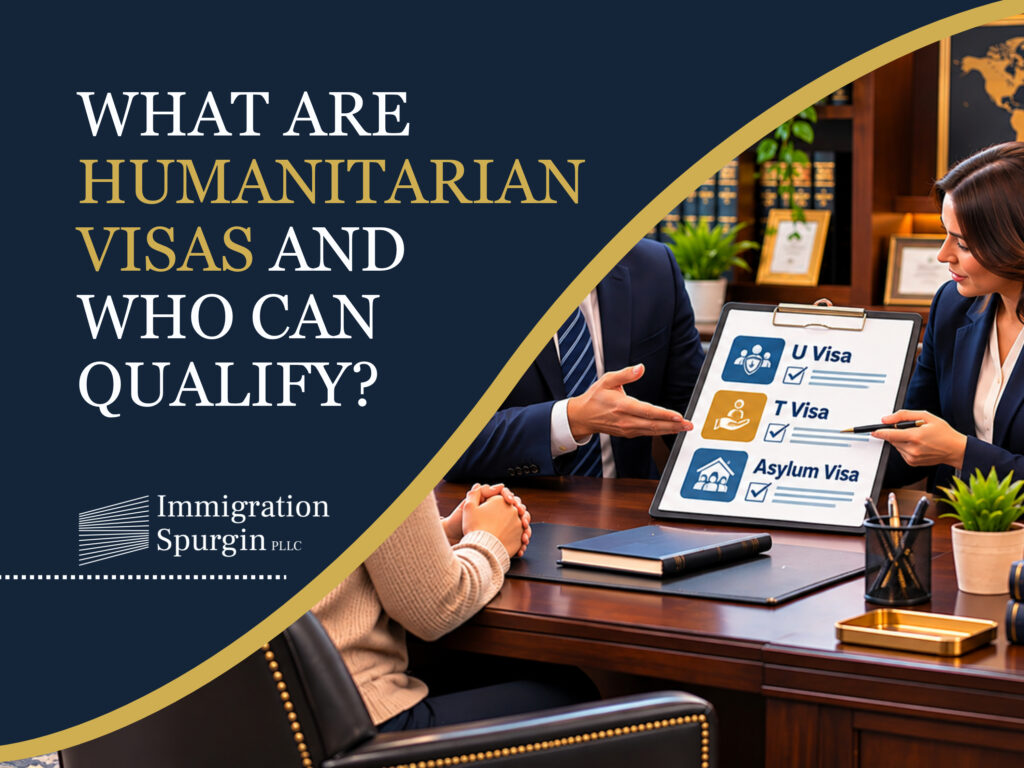
The U.S. immigration system has several types of humanitarian visas, each with its own specific eligibility requirements.
Asylum protects eligible individuals who have experienced persecution or have a well-founded fear of persecution based on their race, religion, nationality, political opinion, or membership in a specific social group.
This relief generally applies to individuals already in or arriving in the United States, and applicants must file within one year of their last arrival in the United States unless an exception applies to their case. Refugee processing is used for those outside the country.
A U visa offers immigration protection to victims of qualifying criminal activity who have suffered substantial physical or mental abuse. Applicants requesting this humanitarian visa must demonstrate that they have been, are currently being, or are likely to be helpful to law enforcement authorities investigating the qualifying criminal activity. U visa applicants have to submit a law enforcement certification signed by an authorized official with their application.
This type of humanitarian visa protects eligible survivors of severe forms of human trafficking, including forced labor and some forms of sexual exploitation. Applicants must meet requirements involving their trafficking experience, physical presence in the U.S., and risk of extreme hardship upon removal.
Cooperation with reasonable law enforcement requests is usually required, although this requirement is subject to exceptions. T visas do not require law enforcement certification.
The Violence Against Women Act allows qualifying abused family members of U.S. citizens or lawful permanent residents to seek immigration protection without relying on their abuser. Eligible VAWA self-petition applicants include abused spouses and children of U.S. citizens or permanent residents, as well as abused parents of U.S. citizens who are at least 21 years old.
Despite the program’s name, VAWA protections are available to humanitarian visa applicants of all genders.
TPS (or Temporary Protected Status) allows qualifying nationals of designated countries temporary protection when returning to their country would be unsafe due to armed conflict, environmental disaster, or other qualifying situations.
Humanitarian parole is a separate discretionary measure that permits temporary entry into the U.S. for urgent humanitarian reasons or significant public benefit.
Neither of these programs automatically grants permanent residence.
Because humanitarian visas are actually several separate programs, the application process you must follow depends on the type of relief you qualify for. Your humanitarian immigration attorney can help determine which forms of relief may be available.
In most cases, the process starts with verifying eligibility. Eligibility requirements for each program are strict, and ensuring first that you are eligible can save you time and effort.
You’ll then need to gather documentation. The documentation you need depends on which type of relief you are requesting. For example, if you seek VAWA protections, you need evidence of the abuse caused by your U.S. citizen or permanent resident family member. If you are requesting a U visa, you need evidence of the criminal activity you were a victim of and your law enforcement certification. Your humanitarian visa lawyer can help identify and gather necessary evidence.
From there, you submit the correct application or petition for your relief type, along with your supporting documentation. Depending on the relief requested, you may also need to attend biometrics appointments, interviews, or immigration court proceedings.
For more than 40 years, Stephen Spurgin, humanitarian immigration attorney and owner of Immigration Spurgin, has helped applicants seek relief. Our firm’s extensive experience in immigration law means that we’ve seen immigration law change numerous times, so we know how to adapt our approach and meet all relevant criteria for your chosen humanitarian relief. Because these cases often involve sensitive or traumatizing information, we handle them with the utmost sensitivity and care.
Whether you know which humanitarian visa suits your situation or you don’t know where to start, our humanitarian immigration attorney is here to help you get started. Contact us to schedule a free case evaluation now.
 (915) 779-2800